
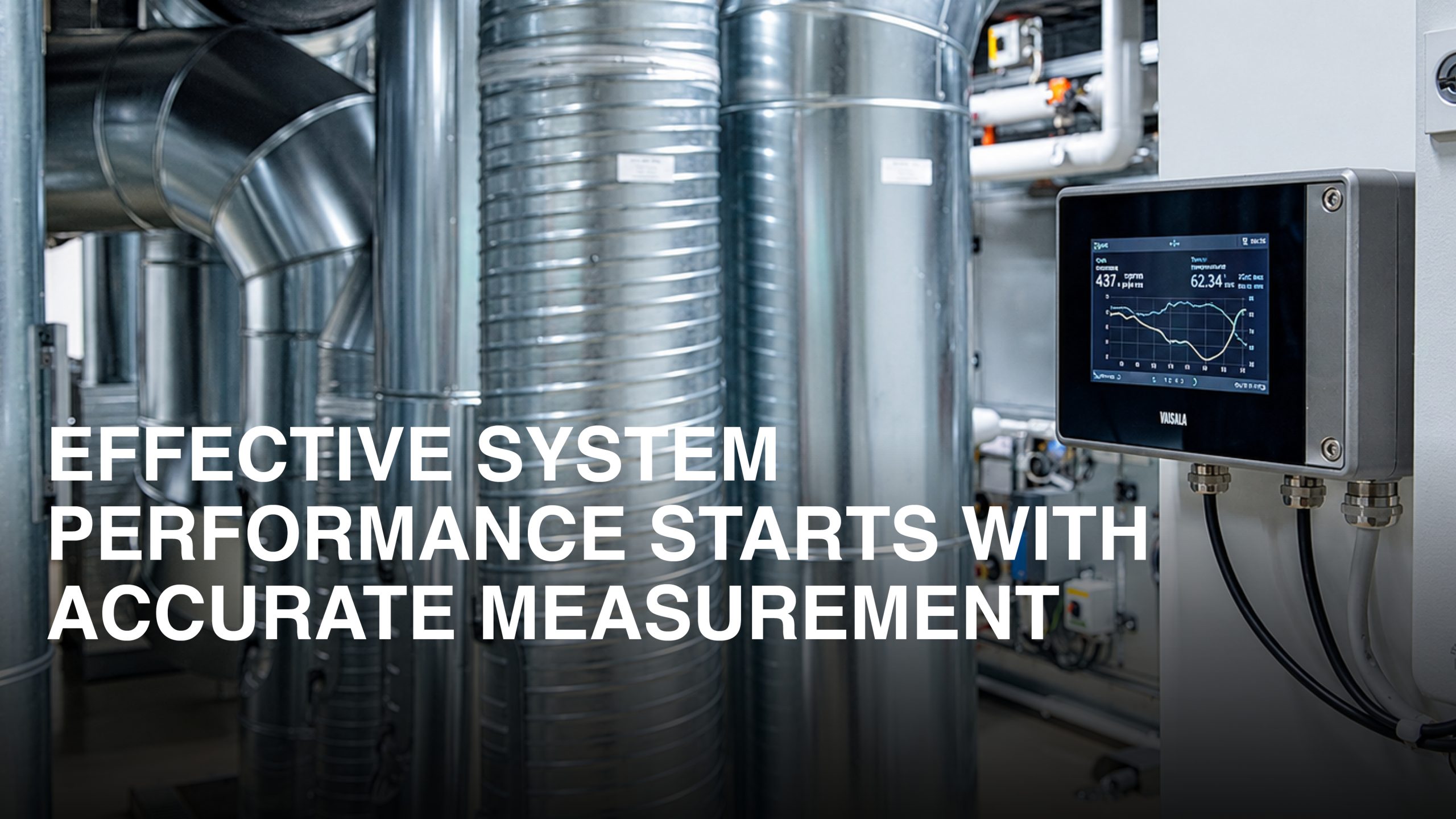
Accurate measurement is vital to effective climate control, but measurement on its own does not control an environment. Its real value lies in what happens next: how that information is used by the HVAC or climate-control system to understand current conditions, respond to change and maintain the environment it was designed to achieve.
At SCE®, we consider measurement as part of the wider control strategy rather than as a standalone component. Every control strategy depends on feedback. Temperature, humidity, CO₂ and differential pressure measurements tell the system what is happening in the environment. That information allows it to compare actual conditions against what is required, determine how equipment should respond and confirm whether the intended conditions are being maintained.
This is where measurement becomes part of system performance, creating a continuous feedback loop between the environment and the HVAC system:
MEASURE → UNDERSTAND → RESPOND → OPTIMISE → VERIFY
When the measurement feeding that loop is stable and trustworthy, the system has a reliable basis on which to respond to actual conditions and adjust its operation accordingly.
Through our authorised partnership with Vaisala, we bring reliable measurement technology together with the engineering expertise needed to integrate that information into the wider climate-control strategy. This means considering what needs to be measured, how that information reaches the control system, how the system needs to respond and how achieved conditions will ultimately be verified.
Consider a dehumidification system designed to maintain a defined humidity level. The equipment may have the capacity to achieve the required condition, but it depends on reliable feedback to know what is actually happening in the space and when its operation needs to change. If that measurement drifts over time, the system may still respond, but it is responding to information that no longer accurately represents the environment.
This is where the quality and stability of the measurement become important. Vaisala’s HVAC instruments are designed for long-term measurement stability, helping maintain confidence in the data supplied to the control system over time. Across selected humidity transmitters, for example, Vaisala specifies stability of ±0.5% RH per year, with different levels of accuracy available to suit different applications.
The same principle applies across HVAC applications, but the demands on the instrument can be very different. CO₂ measurement can provide feedback for ventilation control, while differential pressure measurement can support pressure relationships between controlled spaces. Temperature and humidity instruments may need to operate in anything from occupied rooms to ducts and demanding industrial environments.
Vaisala’s HVAC portfolio provides different accuracy levels, enclosure ratings, installation formats and communication options. This breadth allows us to match the measurement technology to the conditions in which it needs to perform and to the requirements of the wider control system.
The value is not only that something is being measured. It is having measurement you can continue to trust, from an instrument suited to the environment in which it needs to perform.
Through our partnership with Vaisala, we can integrate that measurement capability into the wider HVAC control strategy, giving the system dependable information on which to base its response.
This becomes particularly important in critical environments. In data centres, reliable measurement can influence energy consumption, efficiency and the control of building systems. In healthcare, pharmaceutical and life-science environments, relevant parameters need to be controlled, monitored and verified to support product safety and regulatory requirements.
An HVAC system does not necessarily experience the same load throughout the day. Occupancy changes. Outdoor conditions change. Heat and moisture loads change. Processes start and stop. The conditions a system needs to manage are continually moving.
Accurate environmental feedback gives the control system information about those actual conditions. This allows the wider HVAC strategy to respond to environmental demand rather than relying only on fixed assumptions.
The potential impact can be significant. Vaisala cites average cost savings of 38% across commercial building types using demand-controlled ventilation, where accurate CO₂ measurement allows ventilation to respond to actual occupancy demand rather than operating continuously at a fixed rate.
For facilities, this demonstrates the wider sustainability opportunity. Reliable measurement can help systems use energy according to actual need while still maintaining the conditions the building, process or product requires.
By combining Vaisala measurement technology with our HVAC engineering expertise, we can incorporate reliable environmental data into the wider control strategy and help facilities move towards more responsive, demand-led operation.
Measurement does not end when the system responds. It also provides the feedback needed to determine whether that response achieved the intended result.
If a facility is designed to maintain a particular temperature, humidity or pressure condition, reliable measurement allows operators to see whether that condition is actually being maintained. For critical environments, that ability to verify performance can be just as important as controlling it in the first place.
This closes the control loop:
What is happening? → What should the system do? → Did it achieve the required condition?
For us, this is an important distinction. Measurement is not simply an input into control; it also provides evidence of what the complete system is achieving.
Effective climate control depends on measurement and control working together as part of the same engineered system.
We apply this approach across our DrySPACE®, DryWORKS® and custom HVAC solutions, where environmental feedback helps systems maintain specified conditions. Measurement therefore forms part of the engineering conversation from the beginning rather than being considered only once the wider system has been designed.
Our authorised partnership with Vaisala strengthens this measurement capability, giving us access to a broad portfolio of humidity, temperature, CO₂ and differential-pressure instrumentation that can be specified and integrated into wider control solutions.
The objective is ultimately straightforward: measure what matters, understand what is happening, enable the system to respond appropriately, optimise its operation and verify the result.
That is how measurement moves from being a sensor reading to becoming part of HVAC performance.
Want to understand how Vaisala measurement technology can support your HVAC or climate-control system? Contact SCE® on +27 (0)11 568 4440 or info@sc-engineering.co.za, or read more about Vaisala here https://www.sc-engineering.co.za/products/vaisala/
120a Buckingham Avenue,
Craighall Park,
Johannesburg,
2196