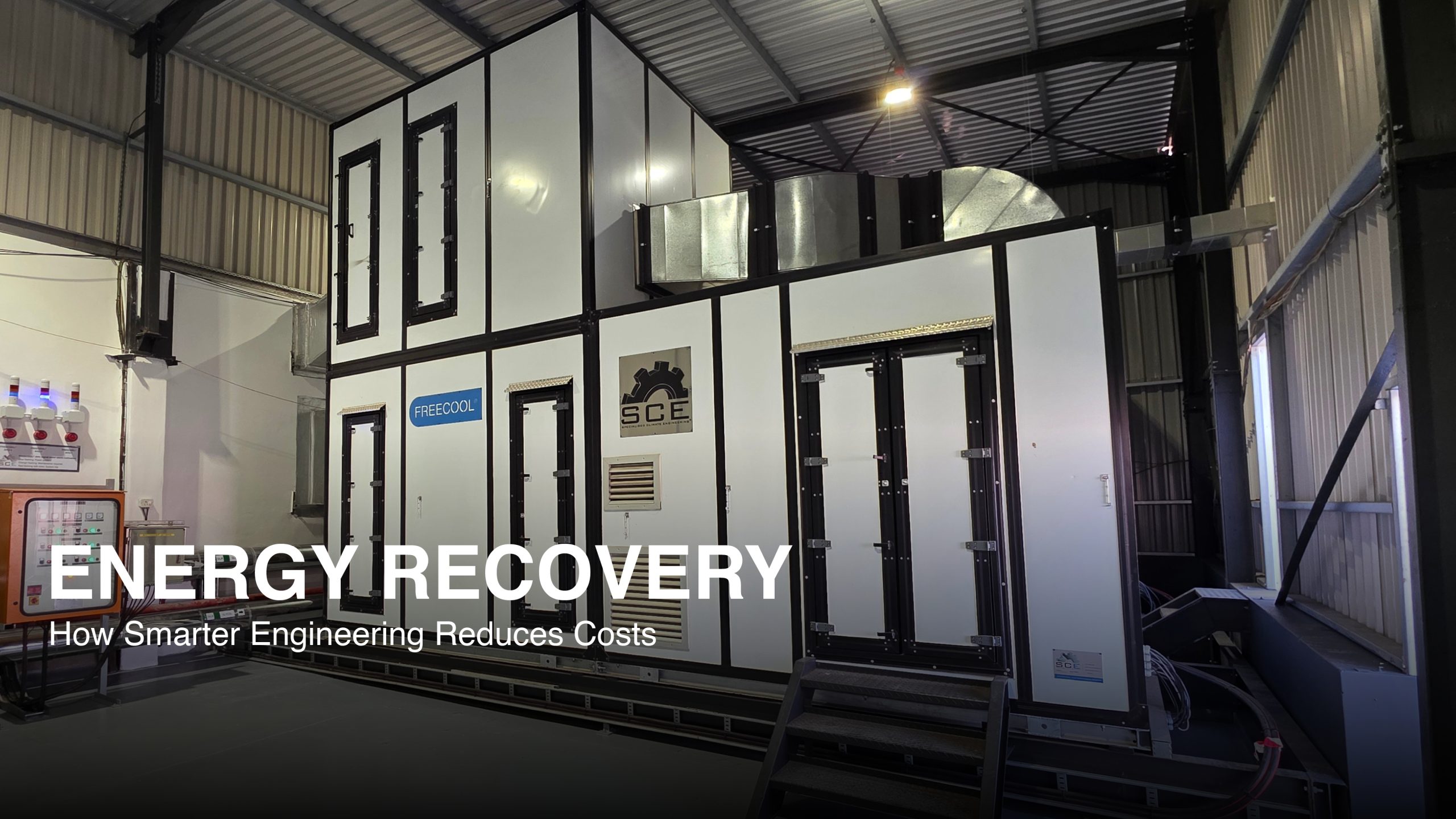
Image Above: SCE FREECOOL® unit installed at an industrial facility
Industrial facilities consume enormous amounts of energy every day. Refrigeration systems, air handling equipment, hot water generation, and production processes all place significant demands on utilities, making energy efficiency in industrial refrigeration and climate control one of the highest ongoing operational costs for many businesses.
Traditionally, improving efficiency has meant purchasing newer, more efficient equipment or negotiating better energy prices. Both have value, but one of the greatest opportunities is often much closer to home: making better use of the waste energy a facility is already producing.
At Specialised Climate Engineering® (SCE®), we believe energy recovery is about far more than capturing waste heat. It’s about engineering the most efficient use of every available energy source, reducing operating costs while supporting long-term sustainability and ESG objectives.
What is energy recovery?
Energy recovery is the process of capturing energy that would otherwise be wasted and putting it back to work elsewhere in the facility.
In many industrial environments, large amounts of valuable heat are simply rejected into the atmosphere as a by-product of refrigeration and cooling systems. Instead of letting that energy go unused, it can often be recovered and repurposed for practical applications throughout the plant.
But heat recovery is only half the picture. Just as important is asking whether the plant is even using the right energy source in the first place, and, wherever possible, reducing how much energy the facility needs to begin with. Get all three right, and the result is simple: less wasted energy, lower operating costs, and improved overall system efficiency.
How does waste heat recovery from refrigeration plants work?
Refrigeration plants naturally generate waste heat during normal operation. Rather than treating this as a by-product to be discarded, SCE® engineers systems that recover this energy and redirect it where it can deliver measurable value. Two common sources include:
- Compressor crankcase oil cooling heat recovery. As a refrigeration compressor runs, the oil that lubricates and cools it picks up heat. Instead of dumping that heat, it can be captured and reused.
- De-superheat hot gas heat extraction. Where available, the hot refrigerant gas leaving the compressor is warmer than it needs to be for the rest of the refrigeration cycle. That excess heat, the “de-superheat,” can be extracted before the gas moves on, without affecting the plant’s cooling performance.
This recovered heat can then be used for several everyday operational needs, including:
- Heating water for SCE®’s fresh-air treatment systems, which bring conditioned outside air into the plant.
- Supplying hot water for boot- and hand-wash stations.
- Providing hot wash-down water for production environments.
By using energy the plant has already generated, rather than generating new energy from scratch, businesses can significantly reduce their reliance on traditional heating methods, such as coal-fired hot water systems or other fuel-intensive alternatives. Every litre of hot water produced this way is a litre that doesn’t need to be heated by burning additional fuel
Is recovering waste heat always the best option?
Not necessarily, and this is where experienced engineering judgement matters most.
At SCE®, every project begins by evaluating the complete energy picture. Sometimes the most efficient solution isn’t recovering heat at all; it’s selecting an entirely different energy source or piece of equipment for the job.
Take additional cooling capacity as an example. When cooling demand increases, many facilities automatically consider installing a new standalone chiller. But if an existing ammonia refrigeration plant has spare capacity and offers a higher Coefficient of Performance (COP), essentially more cooling delivered per unit of electricity consumed, putting that existing infrastructure to work can deliver significantly greater long-term efficiency than adding new equipment.
That said, ammonia plants aren’t always the right call either. In some facilities, the refrigeration plant is already running at full capacity, and expanding it would mean costly, disruptive infrastructure upgrades. In these cases, a standalone chiller can be the more practical short-term solution, solving the immediate demand without a major ammonia plant upgrade, while leaving the door open to plan a longer-term expansion strategically, once the numbers justify it.
The answer isn’t always the same, and it shouldn’t be. The engineering process is about weighing energy efficiency, infrastructure requirements, capital investment, and operating costs together, and selecting the option that delivers the greatest long-term value for that specific facility.
What if there’s no waste heat available to recover?
Not every facility generates enough waste heat to make recovery worthwhile. Where that’s the case, heat pump technology offers an efficient alternative for generating hot water.
Rather than producing heat from scratch through resistive electric elements or fuel-fired boilers, a heat pump moves existing thermal energy from one place to another, similar to how a refrigerator moves heat out of its interior, just in reverse. This makes heat pumps significantly more efficient than conventional electric heating for the same hot water output.
By carefully evaluating each facility’s operating conditions, SCE® selects the most appropriate technology; heat recovery, a heat pump, or a combination – to deliver reliable hot water while minimising energy consumption.
FREECOOL®: putting energy to better use
(South African Patent Application No: 2026/07552)
SCE®‘s FREECOOL® air handling systems are designed around one simple principle: use available energy as efficiently as possible.
Rather than relying solely on conventional heating and cooling methods, FREECOOL® integrates available waste energy into the air treatment process wherever practical. This allows facilities to maintain precise indoor climate conditions while reducing overall energy demand.
The result is an air handling solution that delivers:
- Lower operating costs.
- Reduced energy consumption.
- Improved indoor environmental conditions.
- Long-term operational efficiency.
Instead of treating heating, cooling, and energy recovery as separate systems, FREECOOL® brings them together into one integrated engineering solution.
Reducing energy demand is just as important as recovering it
Energy recovery isn’t only about reusing waste heat, and it isn’t only about choosing the right energy source. Reducing the amount of energy a facility needs in the first place is equally important, and it’s where several of SCE®‘s patented technologies come in.
DryJET-THERMAL® (South African Patent No. 2020/00394)
Every time a freezer doorway opens, valuable refrigerated air escapes while warm, moisture-laden ambient air enters the facility. This forces compressors to work harder to bring the space back down to temperature. DryJET-THERMAL® creates an invisible thermal air barrier across the doorway that dramatically reduces this heat transfer, cutting thermal loss through open freezer doorways by up to 95% compared with traditional freezer curtains, and helping refrigeration systems maintain temperature with far less energy.
DryJET® (South African Patent No. 2020/00393), DryZONE® and DryZONE-PLUS® (South African Patent No. 2017/07311)
Elsewhere on the same freezer, DryJET® creates a similar active air barrier at dock-level receiving and dispatch areas, while DryZONE® and DryZONE-PLUS® form dry-air airlocks on freezer doors themselves, all working on the same principle of keeping warm, moist air out before it ever becomes a refrigeration load. Together, these systems reduce ice and condensation build-up, which in turn cuts the frequency and length of costly defrost cycles.
DryGYRO® (South African Patent No. 2020/01868)
Ice build-up inside gyro, carton, and blast freezers reduces heat transfer efficiency and increases how often equipment needs to defrost. DryGYRO® prevents moisture from entering these freezers in the first place, reducing ice formation, improving freezing performance, and allowing refrigeration equipment to operate more efficiently over longer production runs, with fewer defrost cycles and faster startup after cleaning.
Both technologies reduce energy demand before additional energy ever needs to be generated, creating ongoing operational savings for the life of the facility. In a typical cold storage or meat processing environment, that combination of a reduced refrigeration load and recovered waste heat can meaningfully lower both energy bills and equipment wear over time.
Engineering for long-term value
The most sustainable energy is the energy that never needs to be generated.
At SCE®, every climate control solution is engineered with long-term operational performance in mind. Whether that means recovering waste heat, selecting the most efficient available energy source, or reducing overall refrigeration demand, every decision is focused on improving the total efficiency of the facility.
The benefits extend far beyond lower utility bills. Businesses also gain:
- Lower operating costs.
- Better utilisation of existing infrastructure.
- Reduced fuel and electricity consumption.
- Improved equipment efficiency and lifespan.
- Reduced carbon emissions.
- Stronger alignment with sustainability and ESG objectives.
Smarter engineering delivers smarter energy
Energy recovery is no longer simply about capturing waste heat. Today’s industrial facilities need engineering solutions that evaluate every available energy source, reduce unnecessary demand, and maximise the value of existing infrastructure.
By combining practical engineering expertise with integrated climate control technologies, SCE® helps businesses reduce operating costs, improve operational performance, and build facilities that are both more efficient and more sustainable for the future.
Want to know where your facility could be recovering or saving energy? Get in touch with the SCE® team for a climate and energy consultation tailored to your operation, or explore our energy recovery and freezer protection solutions in more detail.