
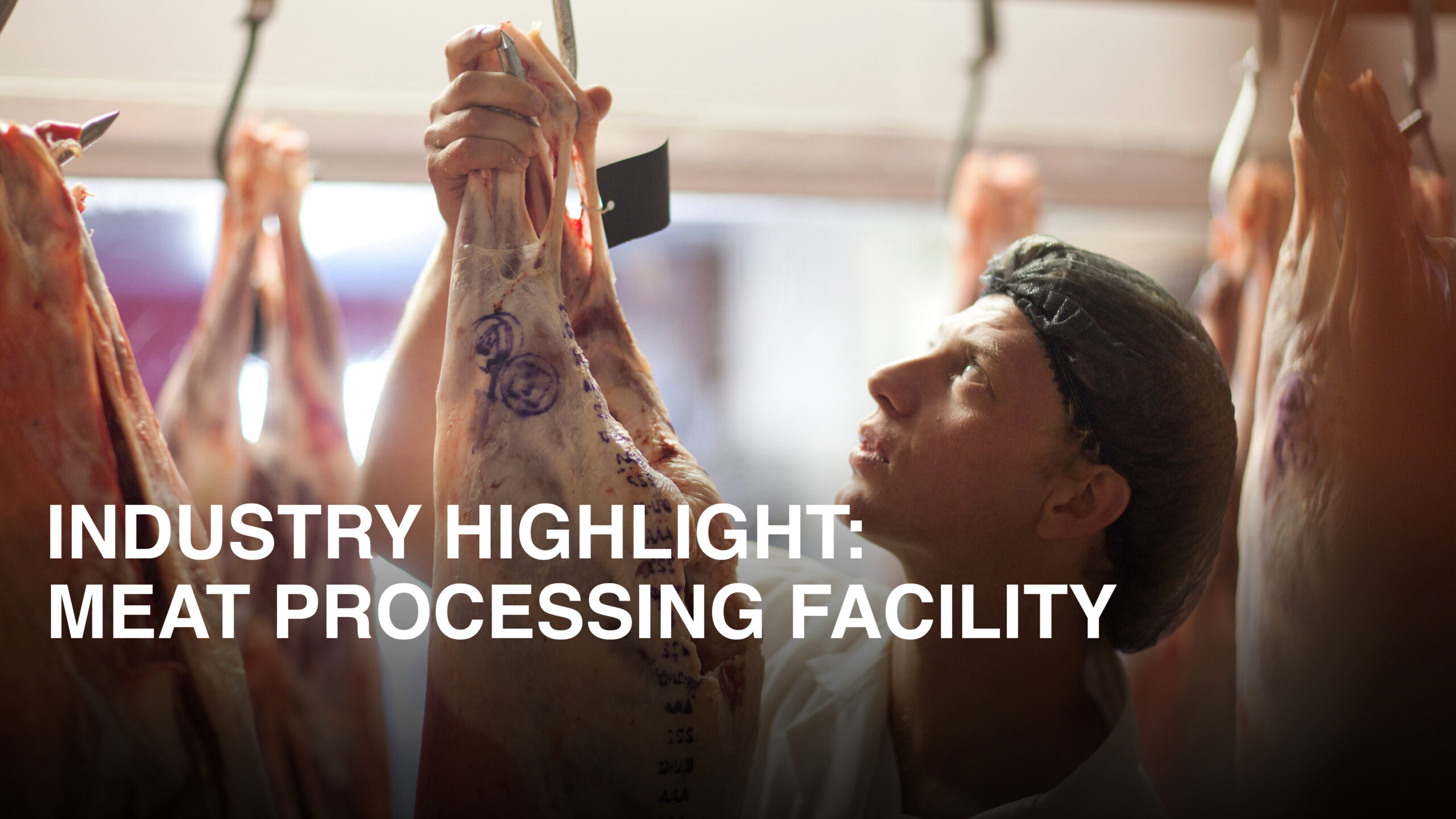
Meat processing facilities in South Africa face unique and demanding challenges: high ambient humidity, fluctuating temperatures, strict food safety compliance requirements, and relentless pressure on energy costs. These conditions create persistent moisture, which hurts building life with condensation on cold surfaces, ice buildup in freezers, and very costly corrosion. These climate challenges compromise product quality, operational efficiency, corrosion cost and regulatory standing.
At Specialised Climate Engineering® (SCE®), we design and implement tailored climate control solutions to help meat processing facilities tackle these challenges at their root. Our FREECOOL®, DryJET®, DrySPACE®, DryGYRO®, and DryJET® Ceiling Diffuser systems are engineered specifically for the demanding conditions of abattoirs, poultry processing plants, meat packaging facilities, and cold logistics operations.
Cold surfaces, such as freezer ceilings, evaporator units, and refrigerated dispatch areas, accumulate condensation naturally when warm, humid air meets cold infrastructure. In meat processing environments, this is not merely a nuisance. Condensation dripping onto product lines, packaging, or floors creates direct food safety risks and creates exactly the warm, moist microenvironments in which pathogens like Listeria monocytogenes thrive.
Listeria is a particular concern in South African processing facilities because it can grow at refrigeration temperatures, and current South African food safety guidelines, rather than enforceable statutory limits, govern acceptable levels in ready-to-eat (RTE) products. This means the responsibility for effective environmental control falls squarely on processors themselves. Climate management is not optional; it is a core element of responsible food safety practice.
High humidity dramatically increases the workload of refrigeration and HVAC systems, which must work harder to achieve and maintain target temperatures. This translates directly into higher electricity consumption and accelerated equipment wear.
South Africa’s electricity tariffs have risen sharply over the past decade, consistently outpacing inflation, and this trajectory is expected to continue as the energy sector transitions and infrastructure investment costs are recovered. For energy-intensive operations like meat processing, managing HVAC efficiency is not a marginal gain; it is a strategic imperative that directly affects the cost of production and, ultimately, competitiveness.
South African meat processors operate within a layered regulatory framework. Ready-to-eat processed meat producers are required under Regulation R908 to hold HACCP certification issued by a SANAS-accredited body. Abattoirs and processing facilities are additionally governed by Regulation R638, which mandates general hygiene requirements for food premises. Processors targeting export markets (particularly the EU, UK, and Middle East) face even more stringent environmental and traceability requirements.
Moisture buildup undermines compliance at multiple levels: it drives microbial contamination risk, accelerates structural corrosion, and creates conditions that are difficult to document and defend during inspections. Modern retail supply chains increasingly require suppliers to demonstrate environmental control as part of broader food safety management systems.
South Africa is a net exporter of beef and a significant producer of processed poultry products. As digital cold chain certification becomes standard practice; driven by major retail groups and export market requirements, the ability to demonstrate consistent, measurable environmental control throughout the facility and supply chain is becoming a commercial differentiator, not just a compliance checkbox. Facilities that invest in robust climate management systems are better positioned to meet the traceability and quality assurance requirements of premium export markets, where South Africa still has significant room to grow its value capture.
No two zones in a meat processing facility share the same climate challenge. The processing floor has different demands from the chiller room, and the chiller room has different demands from the blast freezer. SCE®’s solutions are mapped to each zone — so the right technology is applied to the right environment.
Receiving Areas, packaging halls, staff welfare facilities
These spaces generate significant heat from equipment, steam and constant opening to atmosphere as well as large workforces. Poor ambient and hot, humid conditions reduce staff productivity, increase error rates, and create OHS and HACCP compliance obligations, yet conventional cooling systems do not support the comprehensive climate for HACCP and OHS requirements these facilities require.
FREECOOL®: Energy-Efficient Fresh-Air Make-up and Ambient Cooling
FREECOOL® is SCE®’s advanced range of air handling systems for large-volume controlled spaces. Using extensive options within SCE’s patented designs, the FREECOOL® systems are able to manage temperature, humidity, and fresh air control individually, an extremely unique capability.
Aggressive hot, humid environments such as defeathering, require cool, dry fresh air make-up with negative room pressure extraction control from the FREECOOL® system to ensure this area is managed individually.
The result is a cooler, drier, more productive working environment with dramatically lower operating costs and improved indoor air quality through continuous fresh air supply and balanced extraction.
Chilled production rooms, cold receiving bays, cold dispatch staging, chilled packaging and logistics areas
At temperatures between 2°C and 10°C, the primary challenge shifts from heat to moisture. Warm humid air meeting cold surfaces produces persistent condensation — a direct food safety risk and the environment in which cold-tolerant pathogens like Listeria monocytogenes thrive. Moisture also accelerates structural corrosion and creates OHS hazards at doorways and transition points.
DryJET®: Active Air Barrier for Cold Receiving and Dispatch
Typically installed in dock-leveller situations where cold receiving or dispatch areas are exposed to the ambient environment, DryJET® creates an active air barrier between warm and cold climate zones. It withstands outside wind pressure, provides a reliable thermal barrier, and reduces both moisture ingress and heat infiltration into cold spaces — lowering energy consumption by refrigeration units and significantly reducing floor and ceiling condensation.
DryJET® Ceiling Diffuser” Condensation-Free Ceilings
The DryJET® Ceiling Diffuser is a patented laminar flow outlet that blankets ceilings with smooth, dry air to prevent condensation while simultaneously reducing HVAC demand. Using the Coanda Effect, it delivers wide coverage with fewer diffusers and less ductwork — making it well-suited to the large-span ceiling areas of meat processing facilities, chilled packaging rooms, and cold stores where ceiling condensation is a persistent hygiene concern.
DrySPACE®: Humidity Control Across Processing, Packing and Storage Areas
DrySPACE® actively manages humidity across processing zones, packaging areas, and storage spaces. It maintains the dry conditions necessary to protect products and packaging from moisture damage, comply with HACCP environmental control requirements, and reduce the corrosion potential that shortens the lifespan of processing infrastructure.
Blast freezers, gyro freezers, carton freezers, cold logistics
At temperatures as low as -25°C, the challenge becomes ice. Every time a freezer door opens, warm moist air enters and freezes on evaporator coils and structural surfaces, reducing heat transfer efficiency, triggering more frequent defrost cycles, and cutting into daily production hours. Left unmanaged, ice buildup is a measurable drain on freezer capacity, energy consumption, and throughput.
DryGYRO®: Freezer Efficiency and Reduced Defrost Cycles
DryGYRO® prevents moisture from entering gyro, carton, and blast freezers at source, eliminating the heavy ice buildup that reduces heat transfer efficiency, reduces production capacity and forces more frequent defrost cycles. Practical outcomes include longer production runs between defrosts, faster defrost turnaround, quicker startup after cleaning, and improved blast freezer capacity. DryGYRO® includes DefrostMODE® to facilitate rapid turnarounds and reduce the downtime that cuts into daily production targets.
DryZONE® and DryZONE-PLUS®: Freezer Door Protection
DryZONE® provides cost-effective, entry-level freezer door protection using dry air and strip curtains, removing moisture and ice at the doorway and ensuring HACCP and OHS compliance. DryZONE-PLUS® is the advanced option for high-traffic cold logistics operations, a self-contained air management tunnel that eliminates the need for strip curtains entirely, prevents thermal loss and buoyancy flow, and acts as an effective thermal barrier for facilities where freezer doors open continuously throughout the production day.
Optimised climate systems reduce the electricity consumption of refrigeration and HVAC equipment by addressing moisture at source rather than forcing refrigeration systems to compensate for it. With South African electricity tariffs having increased substantially and further increases expected, the return on investment for energy-efficient climate infrastructure compounds over time.
Less moisture/ice buildup means efficient heat transfer, fewer defrost cycles, less equipment corrosion, longer machinery lifespan, and reduced unplanned maintenance. For facilities running tight production schedules, the reduction in moisture-related downtime directly translates to higher throughput and more consistent output quality.
SCE®’s systems create and maintain the low-humidity environments that limit pathogen proliferation, protect packaging integrity, and provide the consistent, documented environmental conditions that auditors and export buyers increasingly expect. This is particularly relevant as digital cold chain certification becomes standard across major South African retail supply chains.
Reduced energy consumption, lower refrigeration demand, and the utilisation of waste heat recovery in products like DrySPACE® and FREECOOL® contribute meaningfully to a facility’s energy and emissions profile. As ESG reporting requirements extend further into food supply chains, driven by major retail groups and international buyers, demonstrable reductions in energy intensity become a commercial asset.
SCE® has worked with leading South African meat and poultry processors, cold logistics operators, and food manufacturers across the supply chain. Our clients include some of South Africa’s most recognised names in food production and retail, and our systems are installed across abattoirs, poultry processing facilities, blast freezer operations, chilled and frozen logistics distribution centres, and meat packaging plants.
We offer turnkey installed solutions with single accountability, backed by Service Level Agreements that include remote monitoring, regular servicing, and detailed reporting after each service interval. All SCE® systems are covered by a warranty that is extendable up to three years when the SLA is maintained.
If your facility is facing challenges with condensation, freezer efficiency, hygiene compliance, or energy costs, SCE®’s team of climate engineering specialists can assess your environment and recommend a solution tailored to your specific operational needs.
Email: info@sc-engineering.co.za | Phone: +27 (0)11 568 4440
120a Buckingham Avenue,
Craighall Park,
Johannesburg,
2196