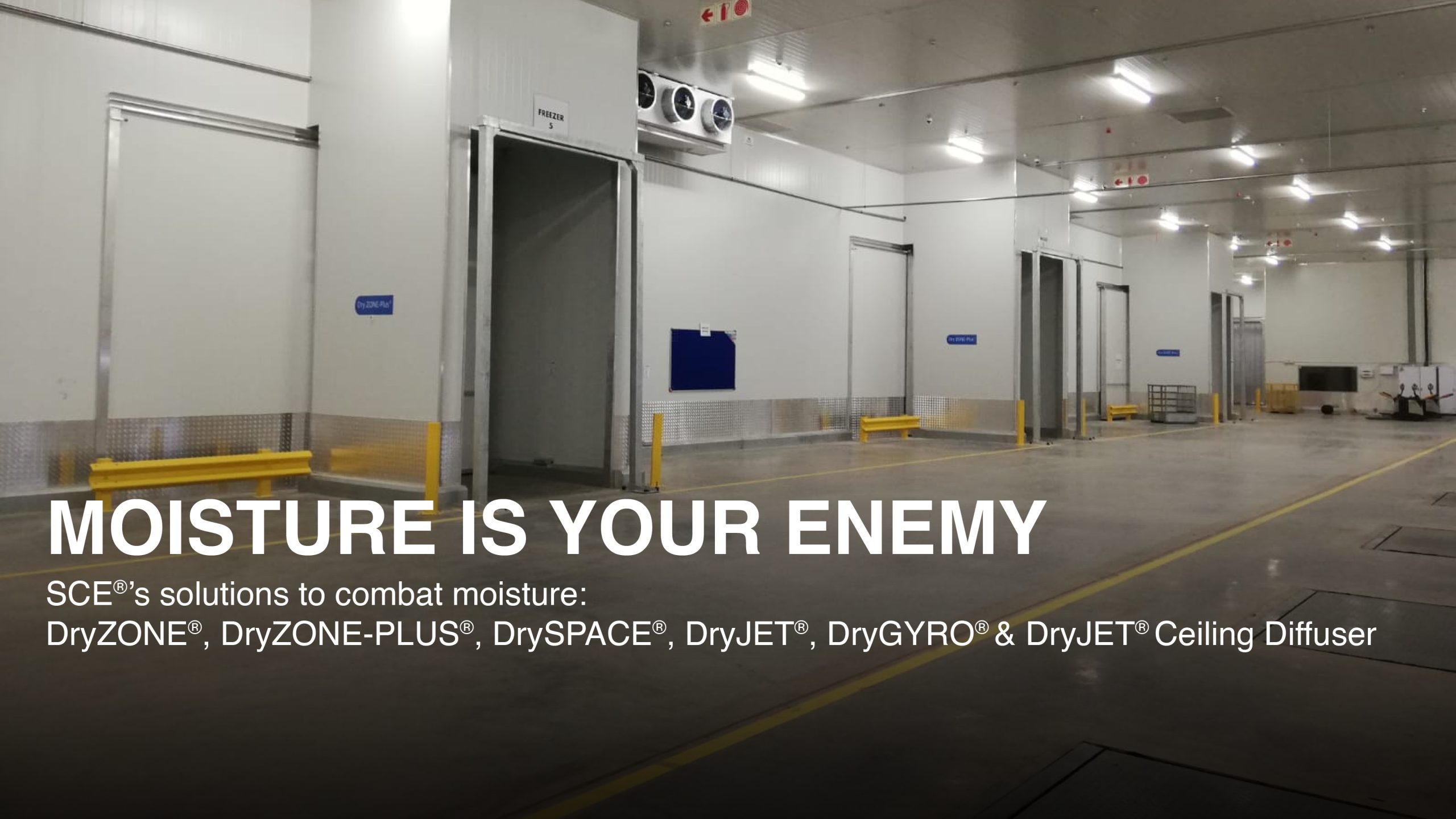
Condensation doesn’t announce itself. It builds quietly on ceilings, creeps into packaging, accelerates corrosion, and one day triggers a HACCP shutdown that costs more than a year’s worth of preventive investment. For businesses operating in cold storage, food processing, and industrial logistics, moisture is not a nuisance — it is an economic risk.
The SCE® Moisture Management Range is a suite of six patented and trademarked climate engineering solutions, each built to address a specific point of failure in cold and processing environments. This guide walks through each product, who it’s designed for, and what it delivers in practice.
1. DryZONE®: Entry-Level Freezer Door Protection
Most condensation and ice problems in freezer facilities start at the door. Every time a freezer door opens, warmer moist air rushes in, meets the cold interior, and deposits moisture. Multiply that by hundreds of door cycles a day and you have a compounding problem that standard strip curtains alone cannot solve.
DryZONE® is an airlock system fitted to freezer doors that uses dry air and strip curtains on both sides to create a controlled thermal, dry-pressurised, buffer zone. It’s the most accessible entry point into the Moisture Management Range — cost-effective, straightforward to install, and immediately impactful.
Best suited for:
- Smaller cold rooms and freezer storage facilities
- Facilities needing HACCP and OHS-compliant door protection
- Operations looking for a low-risk first step in moisture management
What it delivers:
- Eliminates ice and moisture ingress at the door
- Reduces refrigeration plant energy draw
- Keeps the facility compliant without operational disruption
2. DryZONE-PLUS®: Advanced Protection for High-Traffic Operations
Where DryZONE® handles moderate traffic, DryZONE-PLUS® is engineered for environments where freezer doors are opening and closing continuously throughout a shift, cold chain logistics hubs, large-scale distribution centres, and facilities running multiple receiving and dispatch lanes simultaneously.
The system replaces strip curtains entirely with a self-contained air management tunnel that maintains the climate of dry air across the full doorway. This prevents moisture infiltration, eliminates the thermal buoyancy effect (where cold air sinks out and warm air floods in), and removes the maintenance overhead of damaged or poorly positioned curtains.
Best suited for:
- High-traffic cold logistics and distribution operations
- Food storage and pharmaceutical environments with strict climate requirements
- Any facility where strip curtain maintenance is an ongoing operational friction
What it delivers:
- Continuous thermal barrier without the limitations of strip curtains
- Removal of ice and condensation accumulation
- Lower refrigeration load, extending equipment lifespan
3. DRYSPACE®: Condensation Control for Processing Areas
In meat processing facilities, abattoirs, and food packaging environments, condensation on ceilings is more than a housekeeping issue. Drip contamination is a direct HACCP violation. The wet ceilings that result from warm, humid air meeting cold surfaces create an ongoing hygiene risk that operators typically manage reactively — cleaning constantly, never solving the root cause.
DrySPACE® changes that equation by treating the air that interacts with the surfaces. By maintaining controlled humidity in the processing area, it prevents condensation from forming in the first place — on ceilings, on walls, on packaging, and on product.
Best suited for:
- Meat processing facilities and abattoirs
- Cold storage packaging areas
- Any HACCP-regulated processing environment
What it delivers:
- Condensation-free ceilings, removing a primary contamination risk
- Humidity control that prevents mould growth and corrosion
- A proactive compliance position rather than a reactive one
4. DryJET®: Active Air Barrier for Dock-Level Doors
Dock-leveller situations present a unique challenge. Unlike a standard freezer door that opens and closes, dock doors are often partially open for extended periods during loading and unloading, exposing the cold storage interior directly to ambient conditions.
DryJET® addresses this with an active air barrier, a pressurised zone of conditioned dry air that sits between the warm exterior and the cold interior. Unlike passive solutions, it actively resists wind pressure from outside, making it effective even in exposed or windy dock environments.
Best suited for:
- Dispatch and receiving areas with extended open-door exposure
- Cold chain logistics operations requiring a stable indoor climate during loading
- Facilities aiming to reduce refrigeration costs at dock level
What it delivers:
- An active, wind-resistant thermal and moisture barrier
- Reduced refrigeration load during loading and unloading
- Prevention of floor and ceiling condensation in dock areas
5. DryGYRO®: Efficiency for Carton and Gyro Freezers
Carton freezers and gyro freezers are among the most energy-intensive assets in any cold food production facility. Their efficiency depends on clean heat transfer surfaces — and ice buildup is the enemy of that. Every millimetre of ice on an evaporator coil dramatically degrades heat transfer, slows freezing times, and forces more frequent defrost cycles.
DryGYRO® prevents moisture from entering the freezer environment in the first place, which means ice doesn’t accumulate, heat transfer stays efficient, and the freezer runs at its designed capacity for longer between defrosts. The system can be retrofitted to existing gyro, carton, and blast freezer equipment.
Best suited for:
- Frozen food production facilities with blast or gyro freezing equipment
- High-output operations where freezer downtime for defrosting is a bottleneck
- Facilities looking to improve throughput without capital equipment replacement
What it delivers:
- Fewer defrost cycles, meaning longer production windows
- Faster freezing times through improved heat transfer, meaning more production availability
- Reduced energy consumption per unit of frozen product
- Faster post-clean startup and a dry start for clean heat-exchange surfaces
6. DryJET® Ceiling Diffuser: Precision Airflow for Moisture-Free Ceilings
The DryJET® Ceiling Diffuser is a patented laminar flow outlet that takes a fundamentally different approach to air distribution. Rather than directing cold air downward into the room, it uses the Coanda Effect to create a controlled layer of smooth, dry air that follows and blankets the ceiling surface, exactly where condensation forms.
This approach requires fewer diffusers and less ductwork than conventional systems, while delivering wider, more consistent coverage. In environments like meat processing facilities, where ceiling condensation is both a hygiene risk and a compliance issue, it directly reduces HVAC system demand while solving the problem at its source.
Best suited for:
- Food processing plants and abattoirs where ceiling condensation is a compliance risk
- Cold storage and pharmaceutical HVAC environments
- Cold facilities looking to reduce HVAC capital and running costs
What it delivers:
- Condensation-free ceilings through laminar air coverage of ceiling
- Wider coverage with fewer diffuser units
- Lower HVAC system load, translating to energy savings
Choosing the Right Solution for Your Operation
The Moisture Management Range are not interchangeable; each one addresses a distinct operational scenario. Many facilities benefit from a combination: a DryZONE-PLUS® at high-traffic doors, DRYSPACE® managing the processing environment, and a DryJET® Ceiling Diffuser controlling condensation overhead. SCE® approaches every project by understanding the specific conditions first, then recommending the configuration that delivers the best return.
With six registered patents and 14 registered trademarks, our Moisture Management Range represents more than a decade of applied engineering in South Africa’s most demanding cold environments. Every solution comes with a performance warranty and is backed by SCE®‘s ongoing service and monitoring programmes.
Book a Site Assessment
Our engineers will assess your facility, identify your highest-impact moisture risks, and recommend the right combination products and solutions. No obligation.
Email: info@sc-engineering.co.za | Phone: +27 (0)11 568 4440 | Web: www.sc-engineering.co.za